
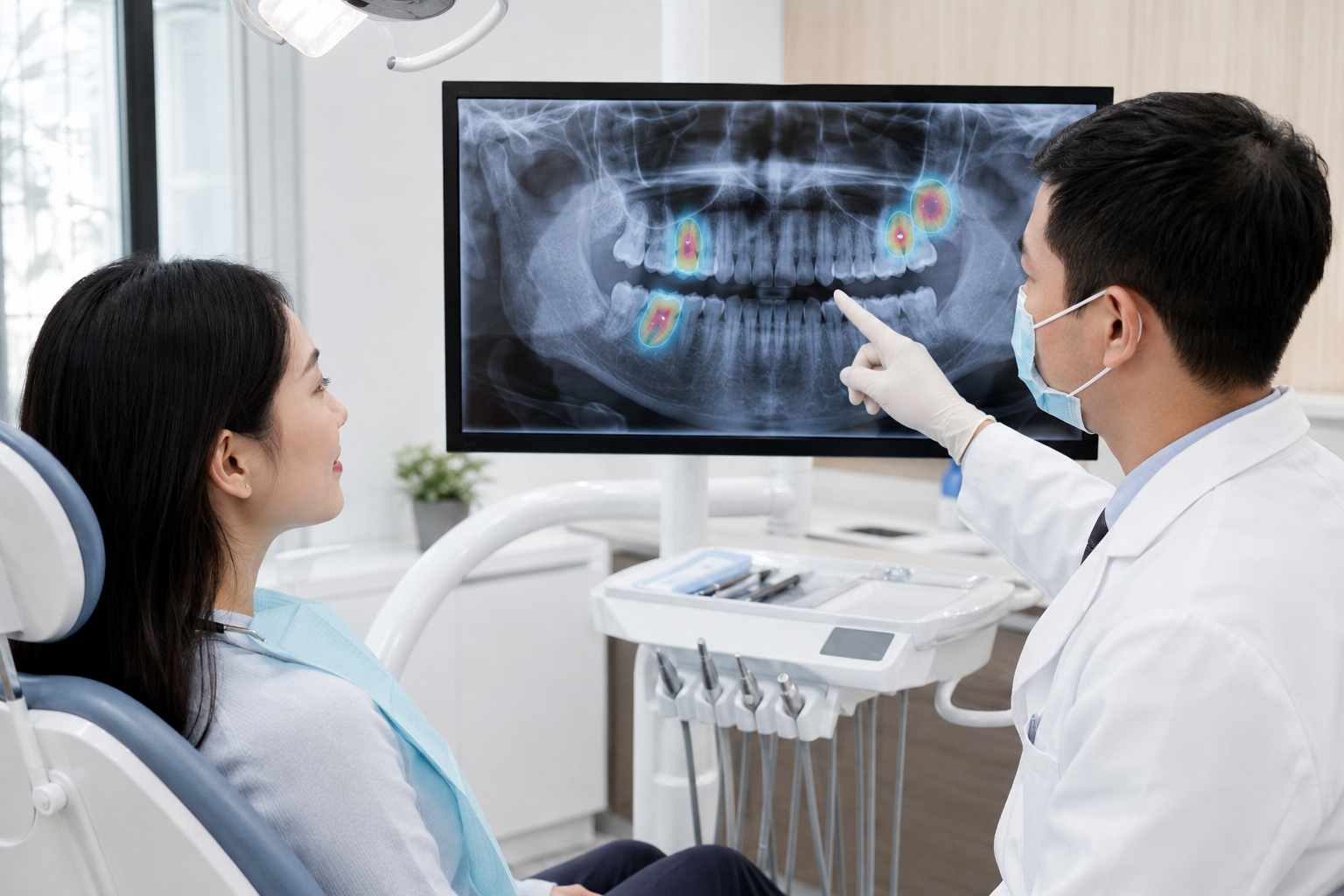
Cavities do not always announce themselves with a toothache. In fact, some decay can develop quietly between teeth or beneath existing dental work, where it may be hard to notice during a routine visual exam. Dental X-rays help dentists see what is happening below the surface, but even X-rays can contain subtle changes that require careful interpretation.
Today, artificial intelligence is beginning to assist dentists by analyzing dental images and highlighting areas that may deserve a closer look. At Highland Kitchener Dentist, technology can support the dentist’s clinical judgment while helping patients better understand what may be happening with their teeth.
Why Can Some Cavities Be Difficult to See?
Tooth decay often begins as a small area where minerals have been lost from the enamel. When the cavity is located on an obvious chewing surface, it may be relatively easy for a dentist to identify. Other cavities can be more challenging.
Decay may be harder to spot when it develops:
- Between neighbouring teeth
- Beneath or beside an existing filling
- Near the gumline
- In areas where teeth overlap on an X-ray
- During the very early stages of enamel breakdown
Dentists commonly use bitewing X-rays to examine areas between the teeth that a visual examination cannot fully capture.
However, interpreting dental X-rays involves looking at many shades of grey. Early decay may appear only as a very small change in the image, which is one reason additional technology is being developed to assist dentists.
How Does AI Analyze Dental X-Rays?
Artificial intelligence systems used in dentistry are generally trained to recognize patterns in large numbers of dental images. When the software examines a new X-ray, it can identify areas that resemble patterns associated with tooth decay or other dental conditions.
Depending on the system, the software may highlight suspicious areas directly on the X-ray so the dentist can examine them more carefully.
Think of AI as an additional set of digital eyes rather than a replacement for your dentist.
A dentist still needs to consider the X-ray alongside your symptoms, dental history, previous X-rays, clinical examination, and the condition of the tooth itself.
Can AI Find Cavities a Dentist Might Miss?
AI may help draw attention to small or subtle areas that deserve further evaluation. This can be especially useful when reviewing cavities developing between teeth or when comparing several areas across multiple X-rays.
However, an AI highlight does not automatically mean a cavity is present.
Dental X-rays can show shadows, overlapping structures, and changes caused by fillings, crowns, or natural tooth anatomy. These can sometimes resemble decay on an image.
For this reason, a dentist should always review AI findings.
At Highland Kitchener Dentist, we use diagnostic technology as part of a broader dental assessment rather than as a stand-alone diagnostic tool. Your dentist ultimately determines whether an area should be monitored or treated.
Why Early Cavity Detection Matters
A cavity usually becomes more complicated as decay moves deeper into the tooth.
When a dentist identifies decay early, they may have more options for managing the tooth. In very early cases, improving oral hygiene, increasing fluoride exposure, and making dietary changes may help slow or stop further enamel damage.
Once decay has created a physical hole in the tooth, a filling is commonly required.
If decay reaches deeper layers of the tooth and eventually affects the nerve, treatment can become more extensive. This may involve procedures such as root canal treatment or, in severely damaged teeth, extraction.
Finding problems before they become painful is one of the main reasons routine dental examinations remain important.
Symptoms of a Cavity to Watch For
Many early cavities cause no symptoms. As decay progresses, you may notice:
- Sensitivity to cold, heat, or sweets
- Tooth pain when biting or chewing
- A visible dark spot on a tooth
- Food repeatedly becoming trapped between certain teeth
- A rough or damaged area you can feel with your tongue
- Persistent toothache
These symptoms do not always mean you have a cavity. Cracked teeth, gum problems, and worn enamel can cause similar sensations.
If discomfort persists or worsens, scheduling a dental examination is the safest way to determine the cause.
How Can You Lower Your Risk of Cavities?
Technology can help dentists identify problems, but preventing decay remains even more important.
Brush your teeth twice a day with fluoride toothpaste, and clean between your teeth daily with floss, interdental brushes, or another method your dental team recommends.
Frequent snacking and sipping sugary drinks can increase the number of acid attacks your teeth experience throughout the day. Limiting how often teeth are exposed to sugar can therefore be just as important as the total amount consumed.
Drinking water regularly, especially after meals, can also help wash away food particles and acids.
Children, teenagers, and adults with a history of frequent cavities may benefit from additional preventive measures recommended by their dentist, such as professional fluoride treatments.
Do You Still Need Regular Dental Checkups?
Yes. AI does not replace routine examinations, professional dental cleanings, or conversations with your dentist.
Regular visits allow your dental team to monitor changes over time. Previous X-rays can often be compared with newer ones to determine whether a suspicious area is stable or becoming larger.
Your dentist can also check your gums, bite, fillings, crowns, and other areas that an X-ray alone cannot fully evaluate.
Preventive appointments are especially valuable because dental problems are often easier to manage before they begin causing pain.
When Should You Book a Dental Appointment?
You do not need to wait until you have a toothache to see a dentist. Consider arranging an examination if you have new sensitivity, pain while chewing, a damaged filling, persistent food trapping between teeth, or any noticeable change in your teeth or gums.
Even when everything feels normal, regular dental checkups can help identify changes that may not yet be causing symptoms.
If you have questions about cavities, dental X-rays, AI-assisted dental imaging, or your oral health, contact the office at 519-885-1598 to book an appointment with Highland Kitchener Dentist.
DISCLAIMER: The advice offered is intended to be informational only and generic in nature. It is in no way offering a definitive diagnosis or specific treatment recommendations for your particular situation. Any advice offered is no substitute for proper evaluation and care by a qualified dentist.